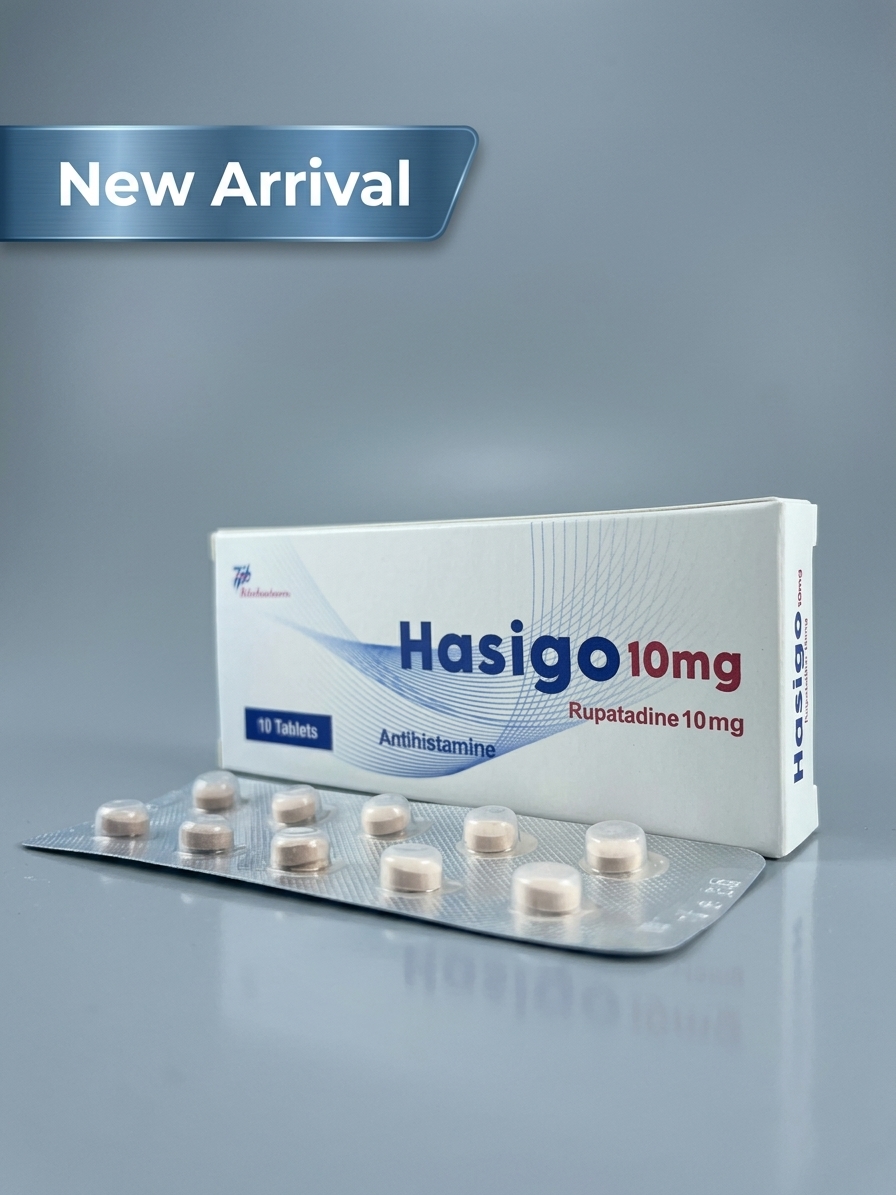
HASIGO® tablet—Rupatadine 10 mg
SKU: ph-01
1. Pharmacological Profile
H1-Antihistamine Activity
Histamine is an important mediator of the early allergic response and produces several symptoms through activation of peripheral H1 receptors.
Rupatadine acts as a selective peripheral H1-receptor antagonist, inhibiting histamine-mediated allergic responses. [1,2]
PAF Antagonist Activity
Rupatadine also has antagonist activity at platelet-activating factor (PAF) receptors.
PAF is an inflammatory mediator involved in allergic and inflammatory processes. Experimental and clinical literature has investigated the contribution of PAF to allergic rhinitis and other inflammatory responses. [2,3]
Dual Pharmacological Activity
Rupatadine therefore combines H1-receptor antagonism and PAF-receptor antagonist activity.
The clinical relevance of the additional PAF activity should be interpreted in the context of available clinical evidence; pharmacological activity alone should not be interpreted as proof of superiority over other antihistamines. [1,2]
2. Pharmacokinetics
Rapid Absorption
Following oral administration, rupatadine is rapidly absorbed.
Published pharmacokinetic data report a time to maximum plasma concentration (Tmax) of approximately 0.75–1 hour after administration. [2]
Clinical literature has also described rupatadine as having a relatively rapid onset of symptomatic activity. [3]
Medical note: Tmax is a pharmacokinetic parameter and should not, by itself, be interpreted as an exact measure of clinical onset in every patient.
3. Clinical Evidence in Allergic Rhinitis
Clinical Evidence
Rupatadine has been evaluated in randomized controlled clinical trials involving patients with allergic rhinitis.
Clinical studies have assessed symptoms including rhinorrhea, sneezing, nasal itching, nasal obstruction/congestion, and ocular symptoms. A systematic review and meta-analysis of randomized placebo-controlled trials found that rupatadine significantly reduced total nasal symptom scores, nasal congestion, rhinorrhea, sneezing, and nasal itching compared with placebo. [7]
A randomized controlled study in Japanese patients with seasonal allergic rhinitis included 900 patients receiving placebo, rupatadine 10 mg, or rupatadine 20 mg. Both rupatadine doses significantly improved the primary nasal symptom endpoint compared with placebo. [5]
4. Evidence with Rupatadine 10 mg
Rupatadine 10 mg vs Cetirizine 10 mg
In a randomized, double-blind, multicentre study of seasonal allergic rhinitis, 249 patients received either rupatadine 10 mg once daily or cetirizine 10 mg once daily for two weeks.
The mean total daily symptom score was 0.7 in both treatment groups. Overall efficacy and safety were comparable, while some secondary analyses showed earlier differences that were not maintained at the second week. [4]
Rupatadine 10 mg vs Loratadine 10 mg
In another randomized study involving 339 patients, rupatadine 10 mg and 20 mg were compared with loratadine 10 mg. The study found lower mean total daily symptom scores with rupatadine in the per-protocol analysis, although the difference was not statistically significant in the intention-to-treat analysis. [3]
Interpretation
These studies support the efficacy of rupatadine 10 mg in allergic rhinitis. However, individual comparative studies do not establish universal superiority over other second-generation antihistamines. [3,4]
5. Nasal Congestion
Clinical Evidence
Nasal congestion is one of the principal symptoms assessed in allergic rhinitis clinical trials.
Rupatadine 10 mg has demonstrated improvement in nasal symptoms, including nasal obstruction, in controlled clinical studies. An objective rhinometric study also reported a reduction in nasal obstruction with rupatadine 10 mg. [5]
The presence of PAF antagonist activity provides a pharmacological basis for investigating rupatadine beyond histamine-mediated mechanisms; however, the clinical contribution of PAF antagonism should be interpreted from clinical outcome data rather than mechanism alone. [2,6]
6. Safety and Tolerability
Safety Profile
Rupatadine has been evaluated for safety in clinical studies involving allergic rhinitis and urticaria.
A global safety review concluded that rupatadine has a safety profile broadly comparable with other second-generation antihistamines. [1]
Somnolence
In a randomized seasonal allergic rhinitis study comparing rupatadine 10 mg with cetirizine 10 mg, the most frequently reported adverse events included headache, somnolence, and fatigue/asthenia.
Somnolence was reported in 9.6% of patients receiving rupatadine 10 mg and 8.5% receiving cetirizine 10 mg in that particular study. [4]
In a Japanese randomized study, somnolence was reported in 7.0% of patients receiving rupatadine 10 mg. No serious adverse drug reactions were observed in that study. [5]
Important Medical Statement
Rupatadine should not be described as completely free from drowsiness or sedation. Somnolence is a recognized adverse event and individual responses may vary. [4,5]
7. Cardiovascular Safety
QT/QTc
The available clinical literature has not identified a clinically relevant QT/QTc prolongation signal at recommended therapeutic use.
However, cardiovascular safety statements should always be interpreted together with the current product information, contraindications, precautions, and drug-interaction information applicable to the locally approved product. [2]
8. Allergic Rhinitis and Current Guidelines
ARIA-EAACI 2024–2025
The ARIA-EAACI 2024–2025 guidelines address the use of oral antihistamines among treatment options for allergic rhinitis.
The guideline recommends intranasal corticosteroids over oral antihistamines for appropriate patients and recommends second-generation oral antihistamines over leukotriene receptor antagonists. It also emphasizes that selection among individual oral antihistamines should consider clinical circumstances, patient preferences, and affordability. [6]
Treatment selection should therefore be individualized rather than based solely on pharmacological class. [6]
9. Scientific Summary
HASIGO® contains
Rupatadine 10 mg.
Pharmacological activity
Selective peripheral H1-receptor antagonism + PAF-receptor antagonist activity.
Clinical evidence
Rupatadine 10 mg has been studied in randomized clinical trials in allergic rhinitis and has demonstrated improvement in allergic nasal symptoms compared with placebo. [5]
Pharmacokinetics
Rupatadine is rapidly absorbed, with published Tmax values of approximately 0.75–1 hour. [2]
Safety
Clinical studies describe a generally favorable tolerability profile; however, somnolence can occur and should not be excluded from patient counselling. [1,4,5]
Scientific References
1. González-Núñez V, Bachert C, Mullol J. Rupatadine: global safety evaluation in allergic rhinitis and urticaria. Expert Opinion on Drug Safety. 2016;15(10):1439–1448. DOI: 10.1080/14740338.2016.1221399.
2. Del Cuvillo A, et al. Rupatadine: efficacy and safety of a non-sedating antihistamine with PAF-antagonist effects. Allergo Journal International. 2015. DOI: 10.1007/s40629-014-0011-7.
3. Saint-Martin F, et al. A randomized, double-blind, parallel-group study comparing rupatadine 20 and 10 mg with loratadine 10 mg in seasonal allergic rhinitis. J Investig Allergol Clin Immunol. 2004;14(1):34–40. PMID: 15160440.
4. Martínez-Cócera C, et al. Rupatadine 10 mg and cetirizine 10 mg in seasonal allergic rhinitis: a randomized, double-blind parallel study. Allergy. 2005. PMID: 15864879.
5. Okubo K, et al. Efficacy and safety of rupatadine in Japanese patients with seasonal allergic rhinitis: a double-blind, randomized, multicenter, placebo-controlled clinical trial. Allergology International. 2019;68(2):207–215. DOI: 10.1016/j.alit.2018.08.011.
6. ARIA-EAACI. Allergic Rhinitis and Its Impact on Asthma (ARIA)-EAACI Guidelines—2024–2025 Revision: Part II—Guidelines on Oral and Ocular Treatments. Allergy. 2026.
7. Efficacy and safety of rupatadine in allergic rhinitis: a systematic review and meta-analysis of randomized controlled trials. 2026.
Publication / Regulatory Note
Before publication, Indications, Dosage and Administration, Contraindications, Warnings and Precautions, Drug Interactions, Special Populations, and other product-specific information should be verified against the current Egyptian approved HASIGO® leaflet/SmPC. General scientific literature should not be used as a substitute for locally approved product information.
Our categories

a UK-registered international trading company specializing in the import of road safety products and the export of medicinal plants and food supplements to professional distributors and wholesalers worldwide.
Read More